Cybersecurity
Cybersecurity Career Paths Explained: Which Path Is Right for You?
Explore the major cybersecurity career paths, compare responsibilities and skills, and discover which cybersecurity specialization fits your goals.
Contents
Cybersecurity Career Paths Explained: Which Path Is Right for You?
One of the biggest challenges for cybersecurity beginners is choosing a career path.
Cybersecurity is not a single job. It is a collection of specialized roles that require different skills, tools, and interests.
Understanding these paths can help you avoid wasting time learning skills that do not match your goals.
Why Choosing a Path Matters
Many beginners try to learn everything at once.
This often leads to confusion and slow progress.
Instead, it is usually better to learn cybersecurity fundamentals first and then choose a specialization that matches your interests and strengths.
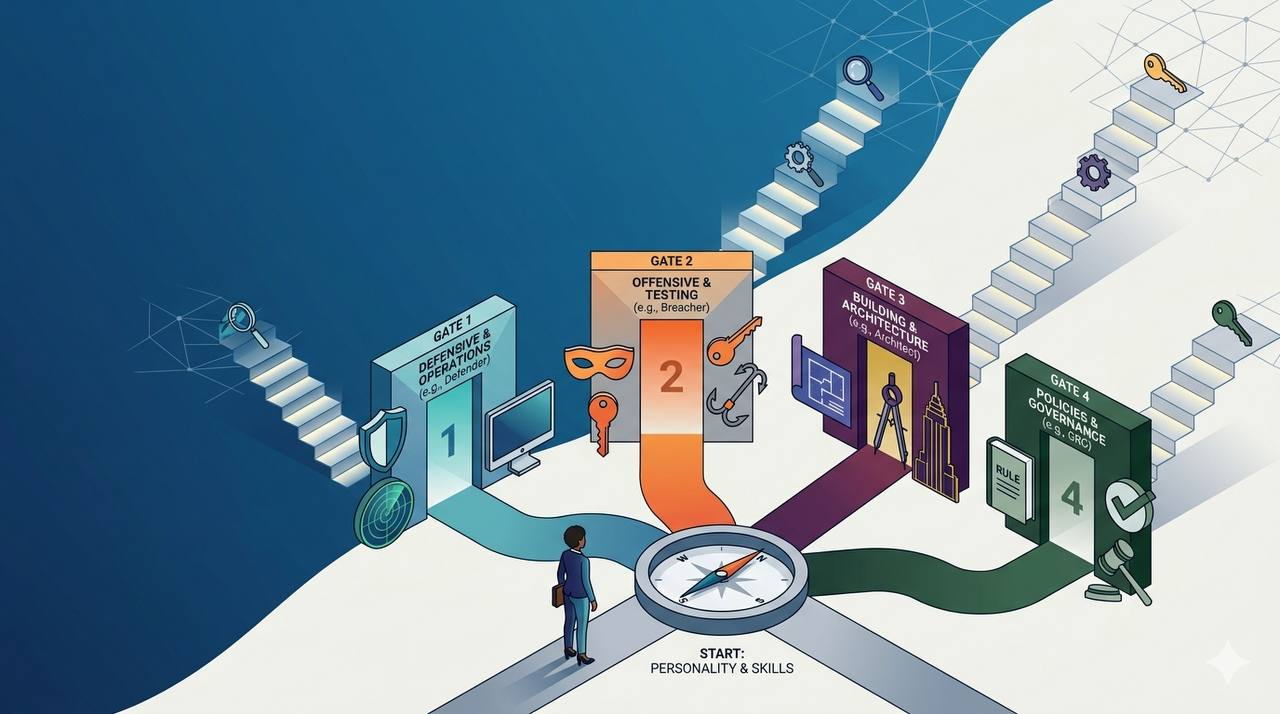
Path 1: Security Operations (SOC Analyst)
Security Operations focuses on monitoring and defending systems.
Typical responsibilities:
- Monitoring alerts
- Investigating incidents
- Reviewing logs
- Threat detection
- Incident response
Best for people who enjoy analysis and problem solving.
Path 2: Penetration Testing and Ethical Hacking
Penetration testers identify vulnerabilities before attackers can exploit them.
Common activities:
- Web application testing
- Network assessments
- Vulnerability analysis
- Security reporting
Best for people who enjoy offensive security and technical challenges.
Path 3: Security Engineering and Architecture
Security Engineers build and maintain security systems.
Responsibilities include:
- Security infrastructure
- Firewalls
- Endpoint protection
- Security tools
- System hardening
Best for people who enjoy designing and implementing solutions.
Path 4: Governance, Risk, and Compliance (GRC)
GRC focuses on policies, regulations, and risk management.
Common tasks:
- Security policies
- Compliance reviews
- Risk assessments
- Audit preparation
Best for people who enjoy business processes and communication.
Path 5: Cloud Security
Cloud security specialists secure cloud environments.
Popular technologies include:
- AWS
- Azure
- Google Cloud
This path continues to grow rapidly as organizations move infrastructure to the cloud.
Path 6: Digital Forensics and Incident Response
These professionals investigate cyber incidents.
Responsibilities include:
- Evidence collection
- Malware analysis
- Incident investigations
- Recovery support
Best for people who enjoy investigation and analysis.
Path 7: Threat Intelligence
Threat intelligence professionals study attackers and emerging threats.
Common activities:
- Threat research
- Risk analysis
- Intelligence reporting
- Trend monitoring
Best for analytical thinkers who enjoy research.
Skills Every Path Requires
Regardless of specialization, all cybersecurity professionals benefit from understanding:
- Networking
- Linux
- Security fundamentals
- Operating systems
- Communication skills
- Problem solving
These foundations support every career path.
How to Choose the Right Path
Ask yourself:
- Do you enjoy defending systems?
- Do you enjoy finding vulnerabilities?
- Do you enjoy building solutions?
- Do you prefer technical work or business-focused work?
- Do you enjoy research and investigation?
Your answers can help guide your specialization.
Final Thoughts
There is no single best cybersecurity career path.
The right path depends on your interests, strengths, and long-term goals.
Build strong fundamentals first, explore different areas, and gradually focus on the specialization that interests you most.

Related articles
Cybersecurity
The Best Countries for Cybersecurity Professionals in 2026
Compare the best countries for cybersecurity careers based on salary, demand, and growth opportunities.
Cybersecurity
The Best Cybersecurity Certifications for Beginners in 2026
A practical guide to the best beginner cybersecurity certifications to start your career in 2026.
Cybersecurity
The Best Free Resources to Learn Cybersecurity in 2026
Discover the best free websites, labs, courses, and platforms for learning cybersecurity in 2026.
Cybersecurity
CEH vs CISSP: Which Cybersecurity Certification Is Better?
Compare CEH and CISSP certifications, career paths, salaries, and job opportunities.
Cybersecurity
Are Cybersecurity Certifications Enough to Get a Job?
Learn whether cybersecurity certifications alone can help you get hired and what employers actually expect.
Cybersecurity
Highest Paying Cybersecurity Certifications in 2026
A practical guide to cybersecurity certifications that can help professionals qualify for higher-paying roles in security, cloud, risk, and leadership.