Technology
Neuralink Explained: The Brain Chip That Could Change Humanity Forever
A clear explanation of Elon Musk’s Neuralink, how the brain chip works, its medical potential, cybersecurity risks, AI connection, and future impact.
Contents
Neuralink Explained: The Brain Chip That Could Change Humanity Forever
What if the next major technological revolution doesn't happen on your phone, your laptop, or even in the cloud?
What if it happens inside your head?
That is the future Elon Musk's Neuralink is attempting to build.
For centuries, technology has expanded human capabilities from the outside. We invented tools to make us stronger, machines to make us faster, computers to make us smarter, and the internet to connect us across the world.
Neuralink takes a completely different approach.
Instead of improving the tools humans use, it aims to improve the connection between the human brain and technology itself.
The idea sounds like science fiction: controlling computers with thought alone, helping people with paralysis communicate, and potentially creating a direct bridge between human intelligence and artificial intelligence.
Yet this is no longer a distant concept.
Human trials are already underway.
The technology is real.
The question is how far it can go.
What Is Neuralink?
Neuralink is a neurotechnology company founded by Elon Musk in 2016.
Its goal is to develop advanced Brain-Computer Interfaces (BCIs), systems that allow direct communication between the brain and digital devices.
Instead of relying on keyboards, touchscreens, or voice commands, a Brain-Computer Interface interprets signals from the brain and converts them into digital actions.
In simple terms, the system attempts to translate neural activity into commands that computers can understand.
How Does Neuralink Work?
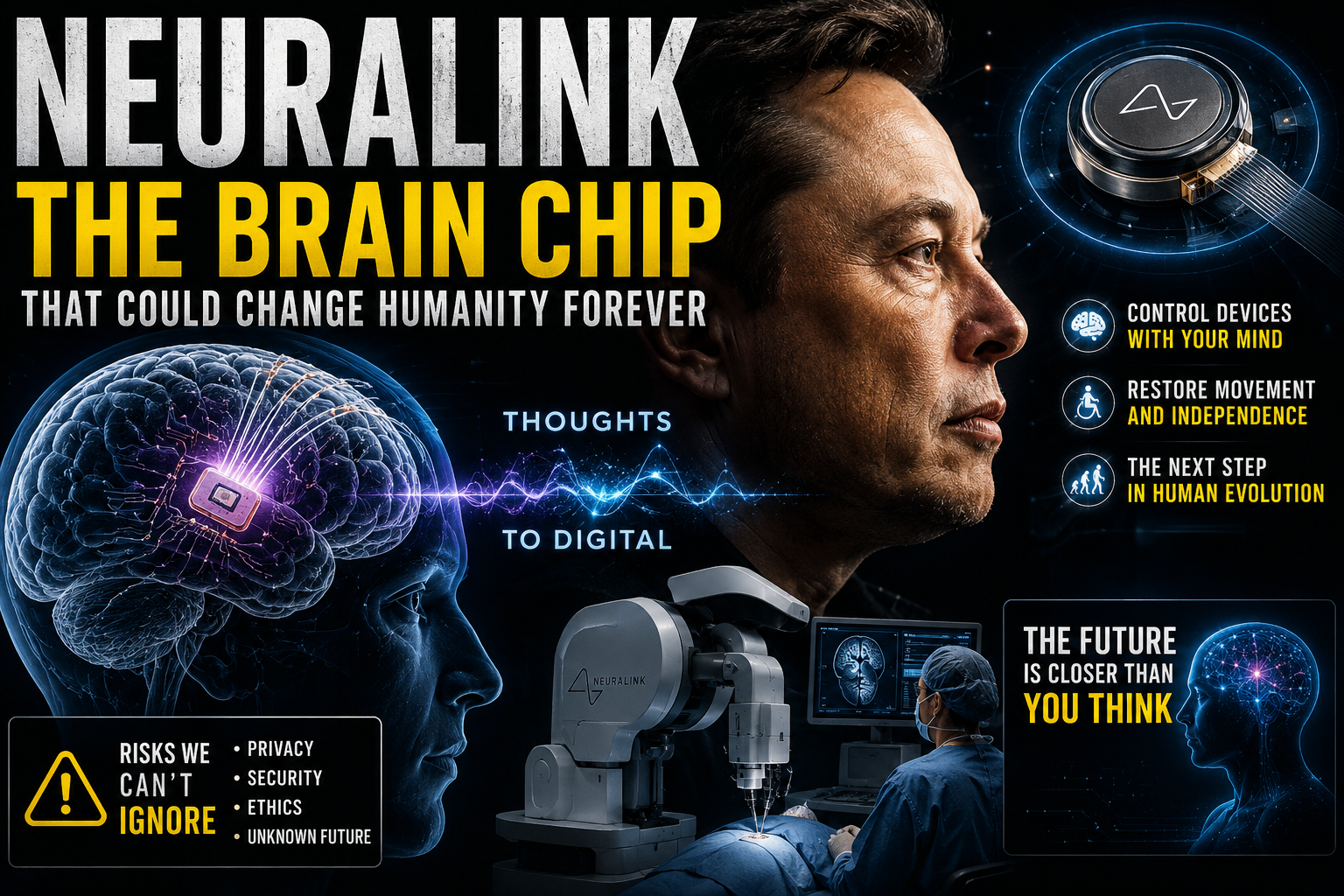
The Neuralink system is built around a small implant known as the N1.
The device is surgically placed inside the skull and connected to the brain through extremely thin threads containing hundreds of electrodes.
These electrodes record neural signals generated by groups of neurons.
Machine learning algorithms then analyze these signals and identify patterns associated with specific intentions or actions.
When a user intends to move a cursor, select an object, or interact with a computer, the system attempts to recognize that intention and translate it into a command.
The result is a direct interaction between the brain and technology.
Why Is Neuralink Important?
The first applications are focused on medicine.
For people living with paralysis or severe physical disabilities, Brain-Computer Interfaces could provide entirely new ways to interact with computers and communicate with the world.
Potential applications include:
- Computer control through neural signals
- Communication assistance
- Advanced prosthetic control
- Research into vision restoration
- Neurological rehabilitation
If these technologies continue to improve, they could dramatically increase independence and quality of life for millions of people.
Could Neuralink Change Human Communication?
One of the most ambitious ideas surrounding Neuralink is the possibility of increasing human communication bandwidth.
Today, every idea must be translated into language before it can be shared.
The brain processes information at extraordinary speed, but communication remains relatively slow.
Supporters of Brain-Computer Interfaces believe future systems could reduce this limitation by allowing more direct interaction between humans and digital systems.
Whether this vision becomes reality remains uncertain, but it represents one of the most fascinating possibilities of the technology.
The Cybersecurity Challenge
As Brain-Computer Interfaces become more advanced, security becomes increasingly important.
Every connected system introduces potential risks.
Computers, smartphones, and cloud platforms all require protection against unauthorized access.
Neural interfaces may eventually require an entirely new field of cybersecurity focused on protecting neural data and brain-device communication.
Questions that once belonged to science fiction are beginning to enter real-world discussions:
- Who owns neural data?
- How should neural information be protected?
- What privacy rights should exist for brain-generated information?
- How can future neural devices remain secure?
While current technology remains limited, these questions will likely become more important as Brain-Computer Interfaces evolve.
Neuralink and Artificial Intelligence
Elon Musk has frequently linked Neuralink to the future of artificial intelligence.
His argument is that AI systems continue to improve rapidly, while human biological capabilities change very slowly.
Some researchers believe Brain-Computer Interfaces could eventually create more efficient ways for humans to interact with increasingly powerful AI systems.
Others argue that such predictions remain highly speculative.
At present, Neuralink's demonstrated achievements are primarily medical rather than AI-related.
However, the discussion highlights the broader significance of Brain-Computer Interface technology.
Risks and Concerns
Despite its potential, Neuralink faces significant challenges.
These include:
Medical Risks
- Surgical complications
- Infection
- Long-term implant durability
- Biological responses to implanted devices
Privacy Concerns
- Ownership of neural data
- Data collection practices
- Long-term information security
Ethical Questions
- Human autonomy
- Informed consent
- Future societal implications
These issues do not necessarily prevent adoption, but they highlight the need for careful development and regulation.
Final Verdict
Neuralink is one of the most ambitious technology projects of the modern era.
Its potential to help people with severe disabilities is already generating significant attention, while its long-term vision raises questions that could reshape medicine, computing, artificial intelligence, and human communication.
Whether Neuralink ultimately becomes a revolutionary breakthrough or a stepping stone toward future technologies remains uncertain.
What is certain is that Brain-Computer Interfaces are no longer science fiction.
For the first time in history, humanity is seriously exploring a future where thoughts can interact directly with machines.
And that future may arrive sooner than most people expect.